
Beyond Interpretation — The Man Behind the Camera
—Anne Cooper, State Park Interpreter I, Interpretation and Education Division

Meet Brian Baer
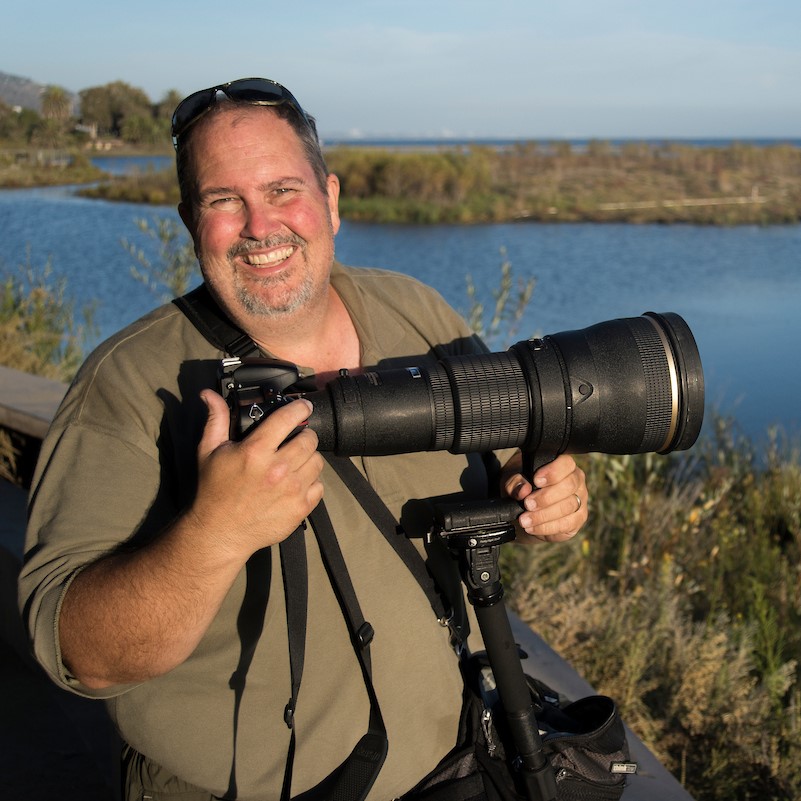
Brian Baer poses for camera while working at Malibu Lagoon State Beach
To those who know his work, it should come as no surprise that Brian Baer has the soul of an artist. After working eleven years as a photojournalist for the Sacramento Bee, Brian found himself laid off in the first round of layoffs by the Bee. Now, with seventeen additional years taking photographs of California’s state parks, Brian expressed no regrets at having joined the department. He explained that as a photojournalist, he’d been telling stories of different people and events. Now, he’s “just telling stories of the parks.”
Division Chief Donna Pozzi (retired) originally hired Brian to the Interpretation and Education Division. Brian’s work for the Department began with the task of producing images for state park brochures – every one of them. Seventeen years later, as part of a much-needed design update, brochures will once again benefit from another round of Brian’s amazing photographs. Brian has been to all 280 parks, all but eighteen of them twice!
During the Department’s reorganization in 2017, Brian transferred to the Communications and Marketing Division, where the work is viewed as servicing “the field” and its needs. Brian’s skills provide images of park landscapes and staff, from field staff to those in executive positions who have portraits created. The work includes the realms of social media, recordings of messages from the Director, photographing District Superintendents at their annual meeting, and a range of other assignments. Brian works with two videographers in the Communications and Marketing Division as well: Jerry Macias and Andres Weishaupt, based in southern California.
When asked about the intersection of his work and interpretation, Brian said that he doesn’t want staff to think that being based in Sacramento means he’s not available. Request Brian’s services through the Photo/Video Request Form or by emailing him directly (if you send an email, he’ll refer you to the form). The form asks for the nature of your request, whether your interest is in a photo or video package, or both, and whether funds have been set aside for the work. Funding is not required, but that information is needed up front. If your park or district would like a special event photographed, notify Brian as soon as possible, so he may fit travel to the park in his schedule. Given sufficient notice and with the revisions of brochures, Brian may be able to fulfill your request by stopping over and capturing an event.
Staff may also access over 50,000 images on PhotoShelter , a viewing platform managed by Brian. Not all images on the platform may be viewed in the galleries, as some relate to law enforcement subjects. Before adding an image to PhotoShelter, Brian catalogs it in TMS (The Museum System). TMS numbers account for those lengthy numeric file names. Brian typically receives ten to fifteen requests a week and fills all orders. Everything in the department is not in the public domain; copyright protects the images.
Speaking of legal issues, Brian noted something he felt all staff should know: a release form is needed to allow for use of a park visitor’s image. Available in both English and Spanish, DPR 993 “Visual Media Consent” forms are collected and kept on file with the photo. When working, Brian has them on a clipboard in his backpack. During events, put up a poster prepared by legal staff notifying those who enter the area that they may be photographed. The poster, too, must be documented with a photo showing its presence. Place it in as many locations as possible. A blanket poster doesn’t work for school groups because that doesn’t secure parental permission. This may be obtained in advance of a field trip, or photographs without faces may be used.
In common with other staff who work in the field, Brian has some stories to tell. The story that came to Brian’s mind occurred at Ahjumawi Lava Springs State Park. Generally, the park may be accessed only by human-powered watercraft (canoe, kayak, paddleboard, etc.). In Brian’s case, the park ranger drove him there using an easement road the day before the shoot. On arrival, a mountain lion made an appearance. Brian remembered thinking “I’m going to be ringing the dinner bell” all the next day! He had no cell phone coverage. The mountain lion didn’t return, although Brian stayed a couple of days.
Another story involves Brian’s devotion to making great images when the light is best, requiring him to rise before the sun. With his gear, Brian left the tent to capture the sky’s display. On returning to the tent, he couldn’t help but notice a “steaming pile of bear dung” deposited close by. It had not been there when he got up and had to have been part of a visit while his tent mate continued sleeping. One of Brian’s tips for those who desire to create great images is to get an alarm clock. At the other end of the day, don’t leave a sunset too soon. Rather, wait for its aftereffects. Brian likes to stay until almost all the light is gone to get dramatic views.
Over the years, drastic changes in equipment have enabled photography. The decision to go digital had just been made when Brian first joined state parks. The previous photographer, John Palmer, received a Hasselblad System camera which back then cost between $60,000 to $75,000! It gave the needed resolution, almost matching today’s cameras. Initially, Brian’s camera wasn’t that good, so he’s now trying to reshoot those early images. Cameras today “see” better in the dark than Brian does and can focus much better than can be done manually. Cameras have come a long way, and they’ve gotten smaller and lighter (reportedly, the Hasselblad System camera was the size of a toaster). The only downside is that today’s equipment requires more battery than previous cameras, since the electric viewfinder is on all the time, drawing the charge faster. Brian also recommends using a tripod any time you can do so, though not with an iPhone. The tripod should be a good one, preferably carbon fiber. For those tight spaces such as interiors at a historic site, try a wide-angle lens.
It hasn’t all been pretty pictures for state parks. In his position, Brian has been called to document damage. He photographed the effects of the 2021 oil spill at Huntington State Beach. Brian also happened to be in Los Angeles for training held on fire prevention when the Palisades Fire occurred. After the fire broke out, it was all live coverage. Of his work, Brian said
All through my life I’ve had the great fortune to document the world as I see it, and people paid me to do that. They didn’t pay me to get their vision of what the world is and what’s going on, whatever event, or what nature scene. They’d always paid me for my vision and, especially for state parks I take this as an honor that I have to do this for the people of California, that I have to document what’s going on in our state parks for the future, for everyone else to see. They need to know that there was a Native American site here a hundred years from now. They need to know that there was an oil spill here in the 2000s that closed the beaches. These are all things that I take as a great honor to do.
Thanks to the efforts of Brian, Jerry, and Andres, Californians will have that record for the future.