
People Who Lived Here: Co-creation Process & Product
—Julie Sidel, State Park Interpreter I, Santa Cruz Mission State Historic Park
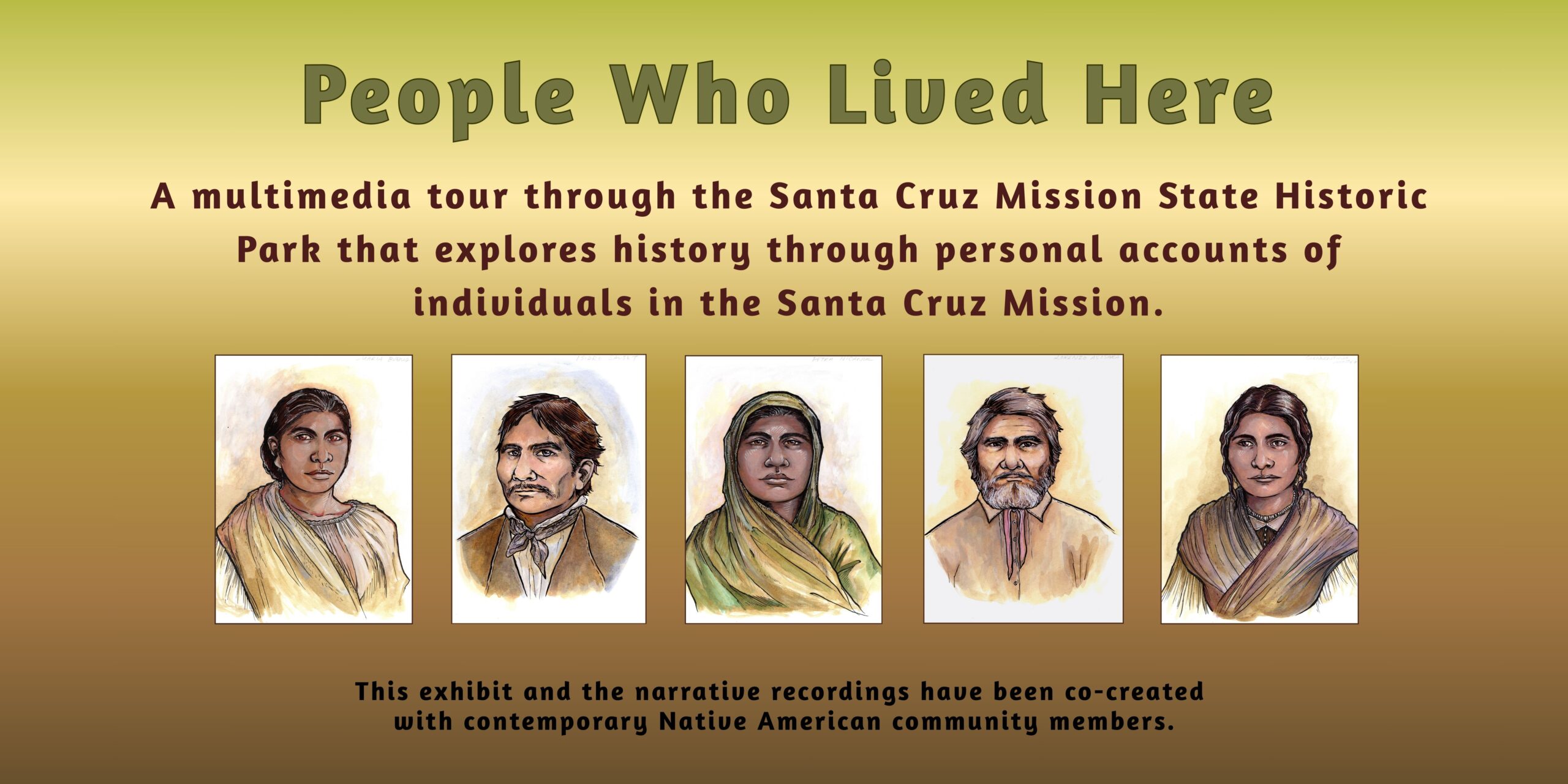
Last autumn the Santa Cruz Mission SHP launched People Who Lived Here (PWLH), a new multimedia tour that tells complex history through narratives of individuals in the Santa Cruz Mission. In this case, the launch event also celebrated the process of how PWLH came into being. As interpreters, it may be valuable to examine that process as it involved tribal co-creation and a state parks virtual platform.
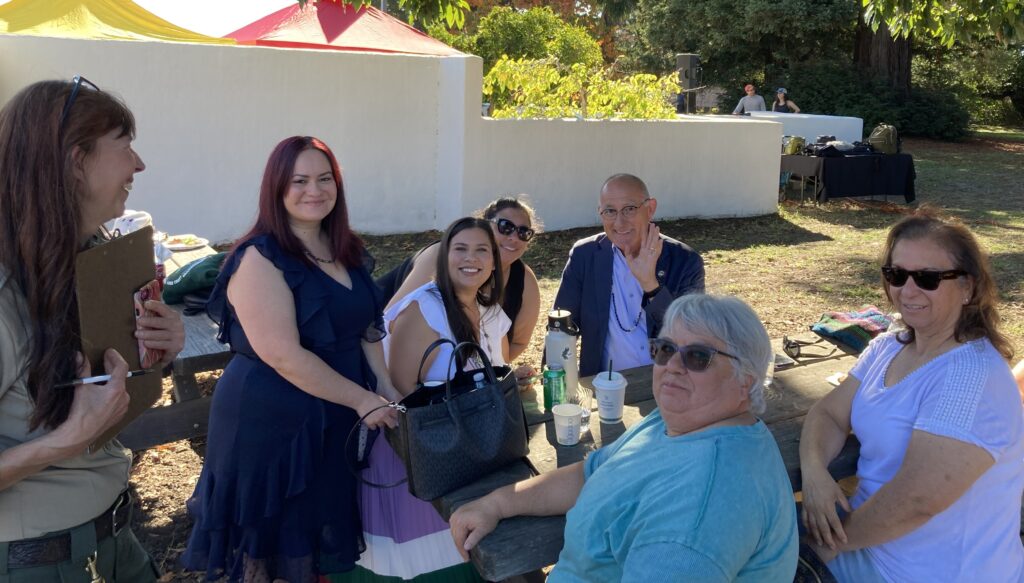
Director Armando Quintero and Interpreter Julie Sidel chat with Amah Mutsun Tribal members including Carolyn Rodriguez(one of the scriptwriters), Julisa Lopez, Robin Najera, Catherine Rodriguez, and Eleanor Castro
The idea of PWLH grew from precedent, opportunity, and need.
Precedent: Learning for Justice shared the idea of biography cards using an example from plantation slavery. We were inspired by the potential power of telling individual stories, but at the time little specific information was available for our mission.
Opportunity: Having a researcher focus on our park was a game changer. When Martin Rizzo-Martinez came into our District as Historian II, his newly published book, We Are Not Animals, used Spanish documents to describe indigenous experiences of the mission. We now had enough material to include individuals.
Need: Most exhibits in the adobe were developed in 1990. While the indigenous experience was centered even then, the language and thrust is outdated. We want visitors to have access to our updated interpretive objectives. And we want to follow through on the commitment of our 2020 Reexamining the Past statement to “work with California Native American people to create a more welcoming place for healing and sharing of personal stories of survival and cultural resilience.”
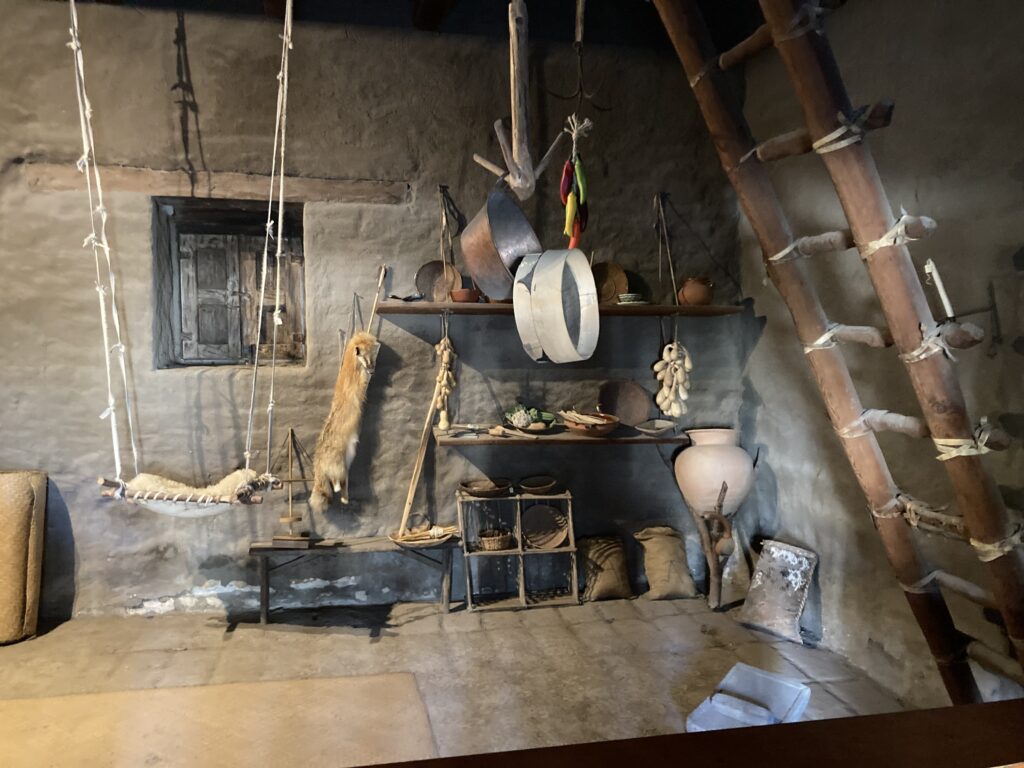
One of the exhibit rooms in Mission Santa Cruz SHP, originally developed in the 1990s, where visitors can now use the Virtual Adventurer app to hear contemporary Native Californians narrate historic Native individuals’ lived experience of the Mission.
What does co-creation look like?
The concept of bullet-list biography cards got extended into scripts, then recordings. An audio tour would be a great way for visitors to opt-in to really hard topics of mission history. Of course this would only make sense if authored and voiced by contemporary Native Americans. As tribal liaison and long-time researcher, Martin had relationships to draw on to make this happen.
CAT K interpretation and education funding was allocated to hire Native American script developers. We were able to compensate them for time spent meeting, planning, training on the research, writing, and editing scripts. Later, Tribal Lands Interpretive Exhibit Project funding covered review processes and participation in the event. There was definitely a dance between standard interpretive delivery and the artistry of the authors. In some cases, we were able to make changes to accommodate their creativity. Though the initial plan was for pieces lasting between 90 seconds and 2 minutes, every script was longer. We turned five stops into eight, and chose to live with longer audio stops. One of the scripts was incredibly beautiful yet intangible. We didn’t change it, but added introductions to scaffold visitor understanding. Once the pieces were edited and reviewed by the team, we treated them as sacred texts. We made a point to use the app in service of those recordings, not the other way around. The result is definitely not a standard interpretive deliverable.
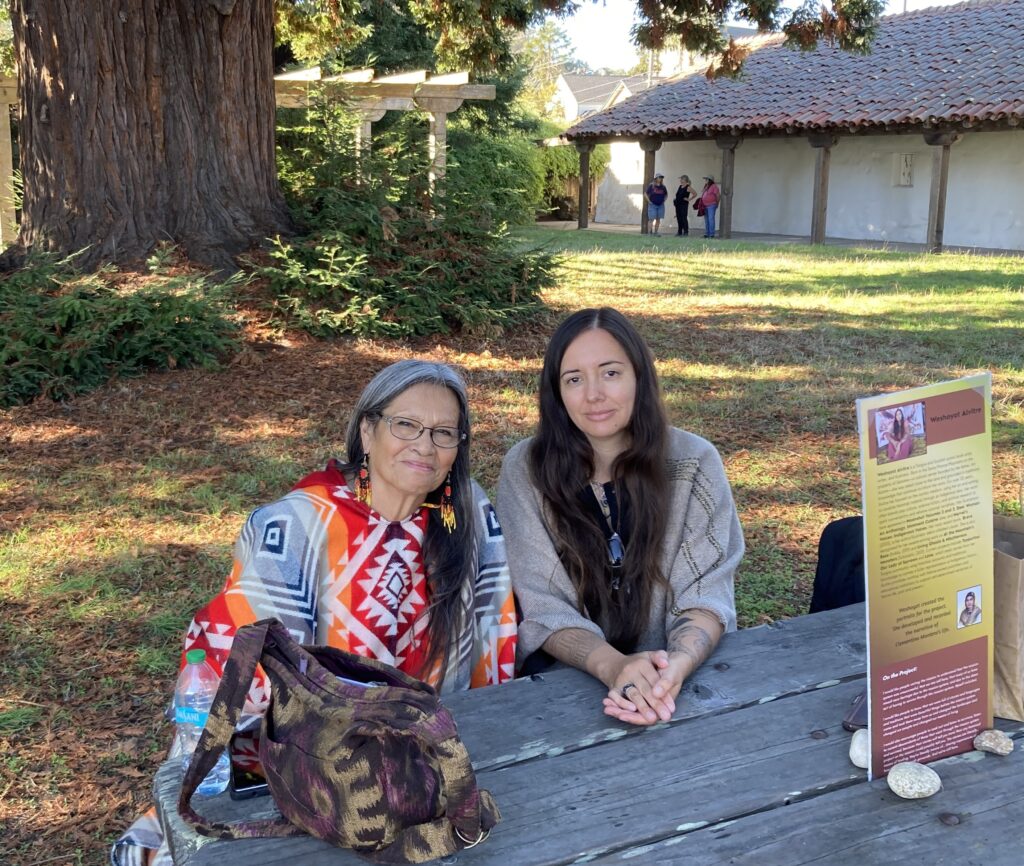
Descendant Linda Lopez-Larios and project collaborator Weshoyot Alvitre.
Choosing the right app
The resulting audio recordings were varied in voice and tone and brought forthright, incisive, and emotional pieces together as an impactful, multi-faceted narrative of life in the mission. Then they sat on the shelf as we planned the move into exhibit-hood. Initially we intended to purchase a simple QR code tool. When Tribal Lands Funding became available, the idea of the Virtual Adventurer platform was introduced. Before climbing on board, we looked at the options carefully.
Pros:
- Being part of a statewide effort
- State Parks would have control over the future of the delivery system.
- Options for visual components, transcripts, accessibility built into the app’s process
- Assistance from state parks staff
Cons:
- It is burdensome to ask visitors to download an entire app. It takes time and a considerable amount of space.
- Existing examples emphasized holograms and videos. We wanted to keep the voices in the forefront.
- The app’s mapping is based on a larger scale than our small adobe rooms, and using it in our space can be tricky for visitors.
- App offers less control over look and feel – the color scheme and themes are standardized.
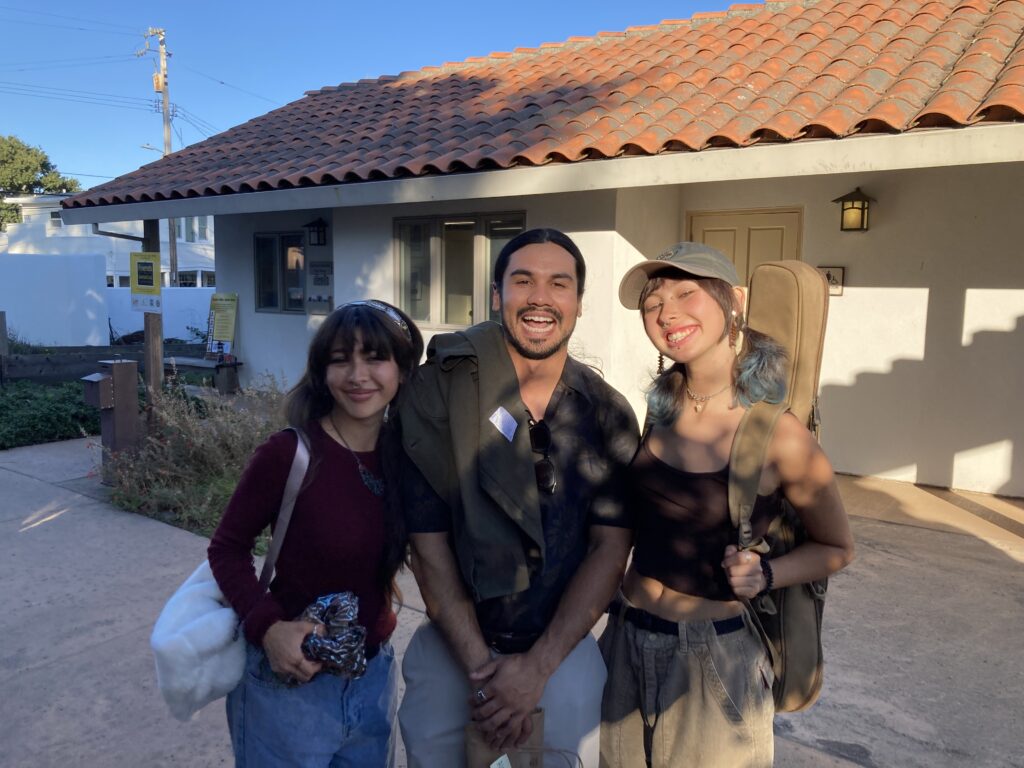
Project collaborator Alexii Sigona (center) with Amah Mutsun Stewards Sophia and Sabella Cordova.
In the end, the Virtual Adventurer route was a great decision. The support from Kayla Jones (KJ) on the PORTS team at Interpretation and Education Division was invaluable, and we were able to mitigate some of the issues that concerned us, including adding QR codes for each site. We even ended up adding some technical fanciness in a 360 degree view of one stop, solving a problem we faced with recorded pieces that didn’t flow naturally.
The release of this exhibit marks the culmination of over three years of visioning and co-creation. That process was built upon relationships between our tribal liaisons and the tribes, the funding and interpretive dance to honor the contributions of our tribal partners, and a vehicle that allows visitors to access the project as part of our park, but also as a representation of the State Parks system.