
Adventure Into the Unknown
—Ann Boggess, State Park Interpreter III, Channel Coast District
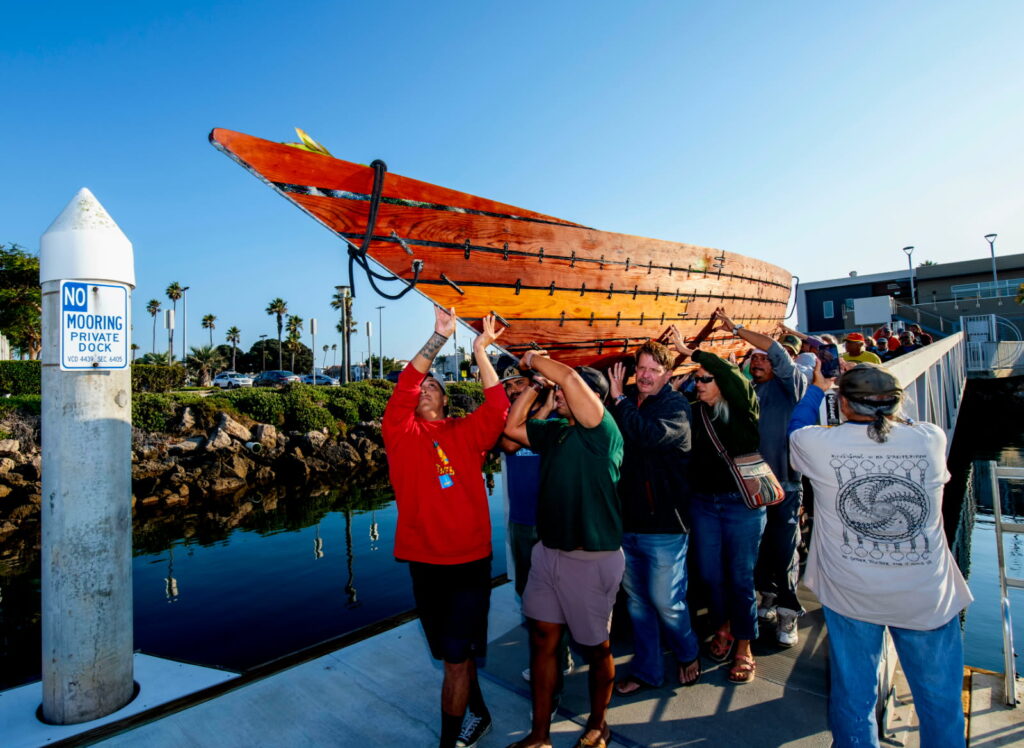
Paddlers transporting the Milimolič hu ‘Aqiwow, weighing 800 pounds, down to the water. Photo by Robert Schwemmer/NOAA.
Leaving in the dark at 3:00 a.m. with stars to guide them, the paddlers set out in their tomol to cross 22 miles of ocean as they head to their homecoming.
This sounds like a scene from a really cool movie but it is actually a very real current event. It began over 20 years ago to celebrate the Chumash maritime culture, which dates back thousands of years. Their plank canoes, called tomols, were an important part of the Chumash economy and way of life. Tomols were traditionally used for fishing, travel, trade, and to connect themselves to other villages and communities. In 1976, Chumash community members reawakened and brought back to life this maritime culture through research in historic accounts of tomol construction. This resulted in the first tomol built in 142 years, named Helek, which means peregrine falcon. Since then, members of the Chumash community undertake the traditional tomol journey across the Santa Barbara Channel from the mainland to their homeland in Limuw, now also known as Santa Cruz Island in Channel Island National Park. The paddle is a big part of the 3-day celebration filled with ceremonies, dances, games, crafts, and lots of singing.
The 22-mile paddle takes a great deal of preparation. The Chumash coordinator of the crossing collaborates with Channel Islands National Parks (CINPS), working within their MOU for the crossing. Another important partner in the crossing is the National Oceanic and Atmospheric Administration (NOAA), which designated the waters surrounding the Channel Islands as the Channel Islands National Marine Sanctuary to protect natural and cultural resources. Both CINPS and NOAA provide support staff and vessels for the crossing to transport paddlers and dignitaries during the event. This year was the first year California State Park staff were invited on the crossing – that staff was me, and as you might imagine, I felt humbled, honored, and shocked to receive the invitation.
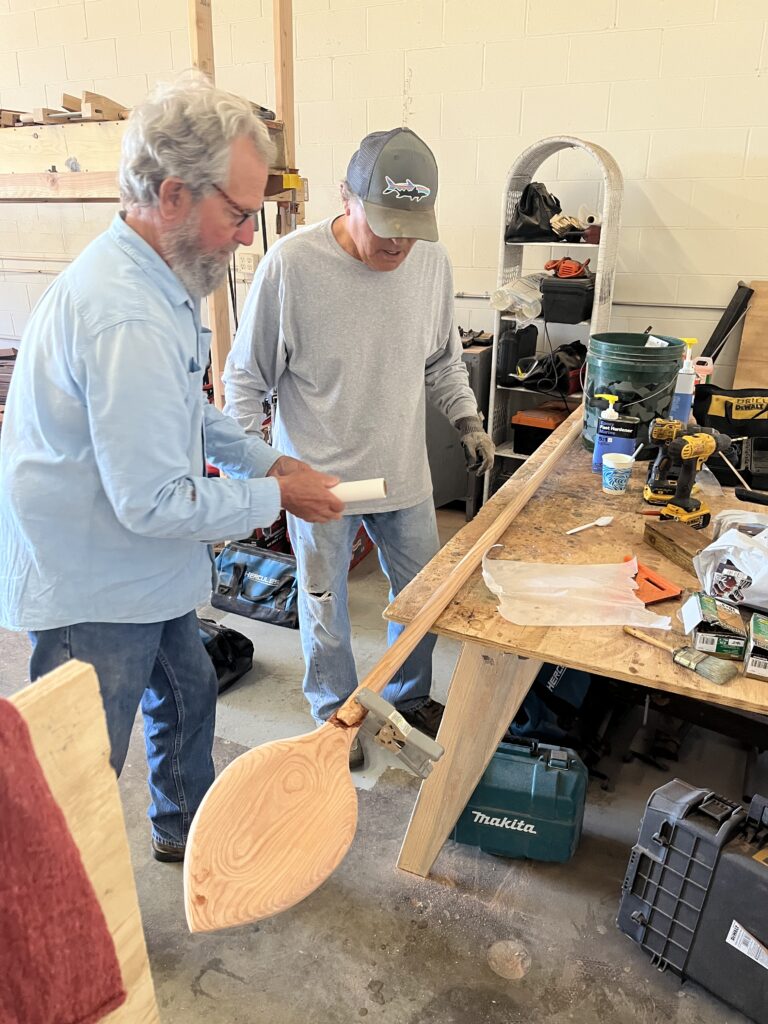
Brotherhood of the Tomol members, Marcus and John, put the finishing binding on a paddle to be used in the crossing. Photo by Ann Boggess.
Over the past five years, my work at La Purísima Mission SHP included seeking Chumash culture bearers who would like to share their voice in our interpretive programs. Along came Tom Lopez, a Northern San Luis Obispo Chumash and language teacher, dancer, paddler, and culture bearer with the Santa Ynez Band Chumash Culture Department. Tom and I worked together in creating the Chumash Life PORTScast as well as the in-person programs for K-12 and public events. He has opened many doors in the Chumash community, bridging a gap to those who might otherwise not have answered a call to share.
One such introduction was in early 2024 to Steve Villa of the Barbareño Chumash Tribal Council and coordinator of the crossing. I asked Steve if he would be interested in sharing about Chumash maritime culture at Carpinteria SB, which led to a Chumash community gathering and tomol practice at Carpinteria SB in June 2024.
This past January, I reached out to see if he was interested in working together again, and he invited me to do the crossing. He said, “I want you to experience the whole thing!” I was speechless, and after a minute, I finally replied with a resounding YES!
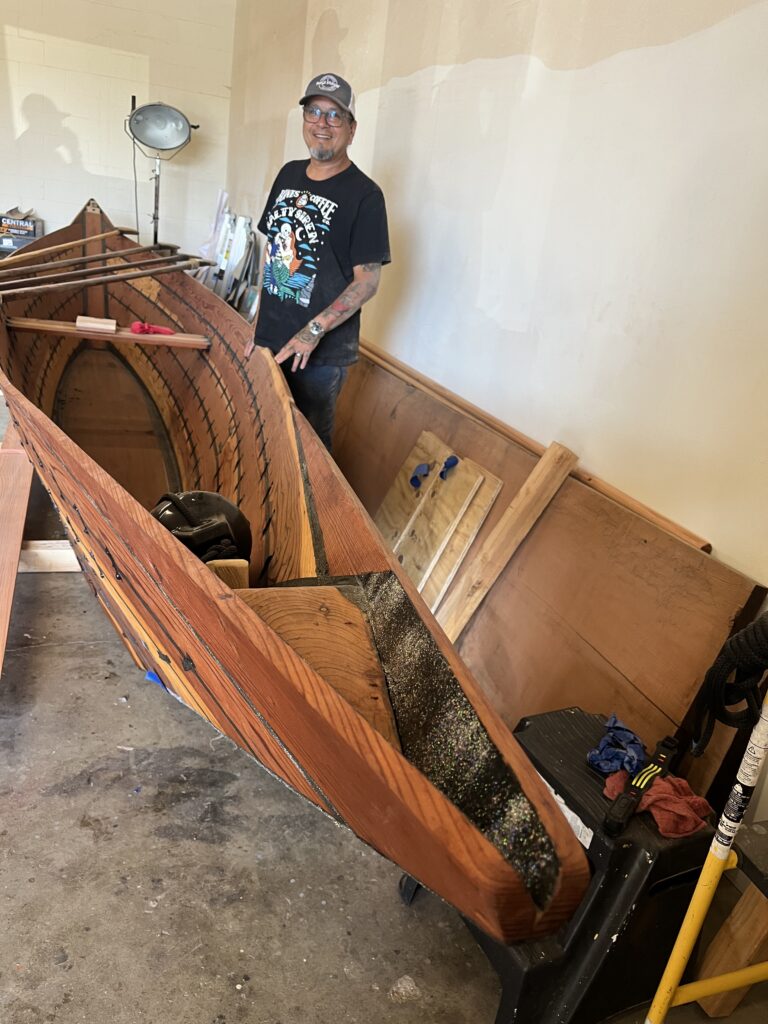
Captain Steve Villa stands next to the newly created Milimolič hu ‘Aqiwow; the Chumash say that tomols are born when they are completed, and they are alive with the spirits of their ancestors. Photo by Ann Boggess.
So began the journey to the crossing, heading into uncharted territory with no idea of all that would unfold, and knowing deep inside it was an adventure I had to experience. With that came the call from Steve inviting us to check out the tomol they were building in their Oxnard workshop. I had read about the special group of men known as the Brotherhood of the Tomol who milled redwood that drifted to the island into planks, sewed them together using cordage made from dogbane and sealed the gaps with yop (a mixture of tar and pine pitch). Now I would see see Steve and Tom and their Brotherhood of the Tomol in action. I met Marcus Lopez Sr. and John Bear, both part of this special group. I have learned in the Chumash way of life that great care is taken in whatever they do, and this is certainly true in tomol building. Tom explained, “We are recreating something our ancestors used, so we have to be in the right frame of mind. We smudge ourselves and the work area before we get started.” Then they get to work steaming the planks in a specially designed rig that pumps steam into an enclosed case. The steam makes the planks flexible so they can be bent onto the form. Once they get the planks in place, they sew them together with cordage and then seal with yop. I watched as they created the Milimolič hu ‘Aqiwow, which means northern star. It took about six months to complete. Steve said, when it is completed, it is born. Great care is given to protect and tend to each tomol as they are living and breathing with the memories of their ancestors.
The next phase in the journey was paddle practice on Saturday mornings at the beach in Santa Barbara. I walked up to our group of paddlers as we gathered around the Milimolič hu ‘Aqiwow on the trailer behind Steve’s truck. About ten of us carried the 800-pound vessel down to the beach. Once there, Marcus prepared a small hole in the sand, lit a bundle of sage, and blessed the practice area while the rest of us worked on getting the equipment out and sandbags filled for the ballast. Everyone gathered in a circle around a ceremonial pole Marcus had stuck in the sand. He walked around to each person, smudging them with sage smoke, and then said a few words about the importance of gathering as a community and working together. Meanwhile, one of the paddlers walked around and gave everyone a pinch of tobacco for the offering to either the sea or into the small fire in the sand.
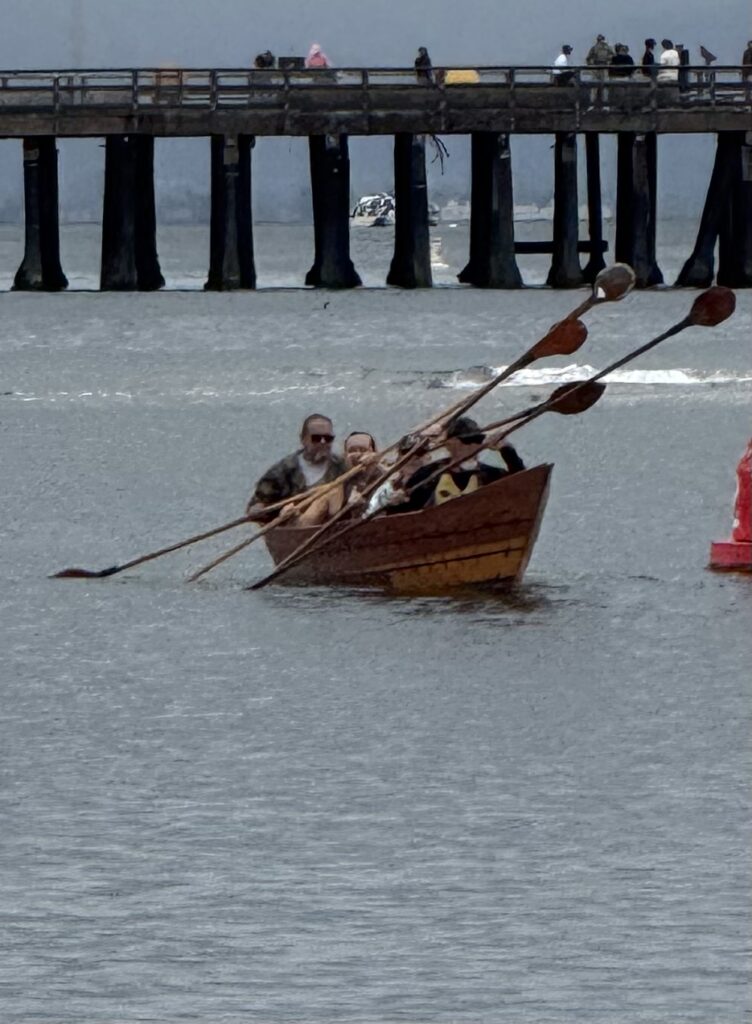
Ann Boggess, sitting in the second seat from the front, paddles with Tom and Steve in the Milimolič hu ‘Aqiwow in Santa Barbara Harbor, preparing for the crossing of the Channel. Photo by Mike Boggess.
Next, the sandbags were used to ballast to weigh down the Milimolič hu ‘Aqiwow in the water and keep it balanced. Like all things tomol, this task received special attention. I heard Marcus tell one of the younger paddlers learning to ballast the tomol, “If you’re upset and your mind isn’t balanced, then get someone else to prepare the ballast. The ocean spirit is powerful and needs to be respected, or it could take your life”. I still think about the truth in that and hope the next generation continues to pass along the wisdom of their elders.
With the ballast set, the time to paddle had arrived. As the first group launched, Marcus and Steve began to sing them out with a song that gave blessings on their health and their paddle. Tom said it was a tradition with the ancestors because those left on shore didn’t know if they would see their paddler’s return.
My turn came next. I climbed into the second seat behind Tom in the front. Tom set the pace; my job was to stay in sync with him. Mike, who I had just met, was in the third seat; his job was to stay in sync with me. Steve served as our navigator steering the tomol. They said the paddlers work in unity and should be one motion like a centipede. After about ten minutes I was feeling it in my arms, but I didn’t want to be the weak link, so I kept going. About fifteen minutes later, Steve gave the “paddles up” command to stop paddling. We coasted to shore where the crew met us and helped us unfold from sitting on our feet. The paddlers varied in age, ability, and experience, and included men and women. I was impressed by the focus on safety, teamwork and encouragement. They made me feel part of the team and were helpful in bringing me along. I was also impressed by the veteran paddlers; Tom, Steve, and Marcus had done the crossing many times before and didn’t display ego. They coached the next generation with care.
Back on shore, the group had grown with Chumash from various tribes and of all ages, from little peeps to elders. Standing there, I could hear children singing. Looking up, I saw two young girls paddling a kayak with big smiles, singing in Chumash, and laughing. Marcus was standing on shore with the girls’ father, and both were smiling at the sight.
Finally, the weekend of the crossing arrived. 50 people had joined a safety meeting the night before, included all the paddlers, support crews, and some elders. Before the meeting started, some of the younger Chumash were playing a rousing game of stick dice. Steve and Marcus opened with smudging and honoring the Ventureño elders. Men singing with clapper sticks and rattles followed. It was impressive. Then we all headed to the Milimolič hu ‘Aqiwow and hoisted it onto our shoulders to carry it down to the water for ballasting and smudging, followed with more songs. The evening ended with pizza in the conference room, and the order to be back at 1:30 a.m. for the final weather check and boarding preparations. Departure would be at 3:00 a.m.
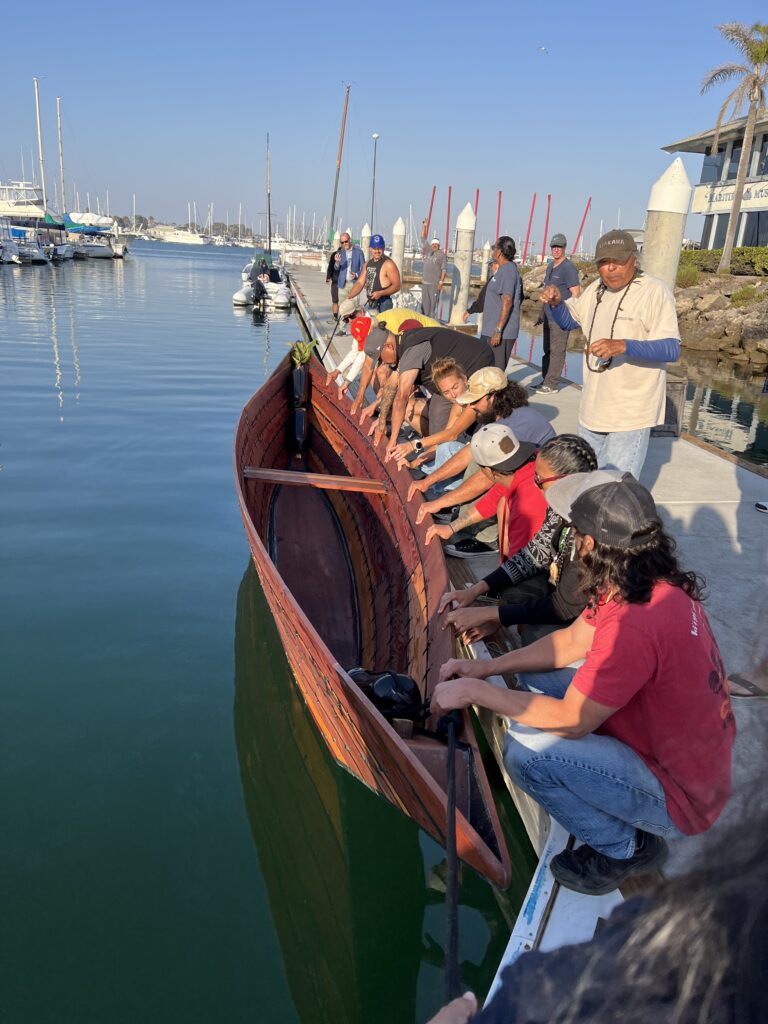
After setting the Milimolič hu ‘Aqiwow (which means Northern Star) in the water, it must be loaded with ballast to stabilize it and provide seating for the paddlers. Photo by Ann Boggess.
At 1:30 a.m. in the low light of the docks, I gathered with 50 others to prepare for departure. A slight breeze blew in the harbor which meant a forecast of high winds for the channel. With that, Steve and Marcus announced the official decision to cancel the paddle. I felt sad not to paddle, but we would still head to the island for the homecoming celebration with the rest of the Chumash community. Marcus lit a sage bundle to smudge the area as the singers broke into song, and we unloaded the ballast from the tomol. Once again, we hoisted the Milimolič hu ‘Aqiwow onto our shoulders to take her back to the trailer, and all received boarding orders for the vessels crossing later that morning.
I boarded a solar-powered trimaran captained by a lifelong sailor. The crew packed 17 of us on board and set out to sail at 7:00 a.m. We were all sleep-deprived and trying not to get seasick in the wind, fog, and swell of the channel. With my double dose of Dramamine, I stayed intact for the five-hour crossing of the Channel. The tomol crossing takes about 7 to 12 hours to complete. Though I have no idea how physically challenging it would be to paddle the tomol across the channel, my own experience was challenging for me, but I was glad I made it without getting sea sick! Once we arrived at Limuw, the women on board began to sing to those on shore who returned the song and sang us in. The island was beautiful, the sun was out, and it was time for lunch. Over 180 Chumash gathered on the island that weekend to celebrate this homecoming to Limuw, the site of their creation story. I could sense the community and their comfort with the place and each other. They were home. Later that night they would have a sweat and more ceremonies, dancing, and songs. I made many new friends on this adventure and learned a few things, too.
It takes commitment to makes this special homecoming possible: coordinating with various agencies, preparing the tomol and the team, preparing the spaces on the island prior to the event, building a sweat lodge, and making space for dancing and ceremony. Not to mention the challenge of just getting to the island. I can only imagine the determination and strength it takes to do the 22-mile channel crossing. The journey the 180 Chumash took was not easy, packing their kids and elders and all their things for the weekend on a boat and traveling a couple of hours in various winds and weather conditions out to Limuw and setting up camp. Sadly some are no longer able to make the journey while others don’t make it due to schedules, illness, and complications. I learned that it is a spiritual journey for some, as one woman I met survived cancer and was there to thank her ancestors at Limuw. Whatever the reason, I saw a community sharing stories, food, playing games, doing crafts, and enjoying their time together. I am grateful I had the opportunity to be part of this crossing. I want to say kaqhinalin (thank you): to Tom Lopez for his generosity in sharing his culture, for opening doors of opportunity, and for his friendship; to Steve Villa for his generous invitation to take part in this; and, to Marcus Lopez Sr. for his hospitality in welcoming me into this very special community.